The Boy Who Harnessed the Wind

Malawian boy triumphs against odds to survive famine, teach himself physics, and use ingenuity to improve his family’s life.

This week I read another memoir – make that 3 in a row! Had been meaning to read for a while, saw there is now a Netflix movie so I hustled to read this. I was also scoping it out as there is a young adult version that I’d like to get my kids to read.
Disclaimer: This book is set in Malawi and thus I was inclined to love it. I spent two years as Peace Corps volunteer teaching secondary mathematics from 1993-1995. I was posted to Ekwendeni, a small town in the northern region of the country. William Kamkwamba was a small child when I was there and lived in a different region of the country, but I fully related to and enjoyed his depiction of Malawian life.
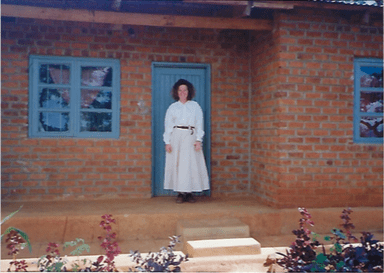
Right: Me, in front of my house in the teachers’ compound… Below: Student life at school…. Still working on figuring out captions and photos LOL.
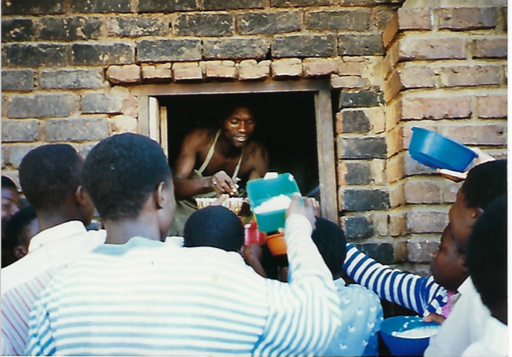
His memoir describes the life of a typical Malawian boy (a girl’s life would be very different!) growing up as a subsistence farmer. His family grows just enough maize to feed themselves with little left over to save to plant for the next year. There is one maize crop a year and it must feed the family for the entire year. There are other vegetables grown, and a bit of tobacco, but to a Malawian, maize and nsima (porridge) are life. A drought occurs in 2000 and the maize crops fail across the country. The government does nothing to intervene and people starve and die. Somehow William and his family manage to survive.

Following this horrific ordeal, William decides to do something to improve his family’s situation. As he could not pay for school, William teaches himself about electricity and physics. He decides to build a wind-powered device which will generate electricity and hopefully one day power an irrigation system so that his family won’t have to worry about lack of rains again. His entire village thinks he is misala, or crazy, but he perseveres.

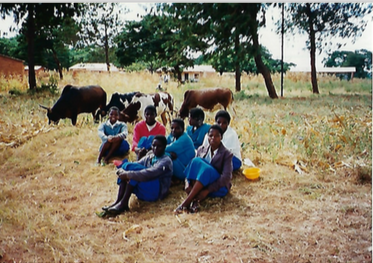
It is a beautifully told story, full of sly humor despite the poverty and circumstances. I loved the description of the schools William attended as I taught in one so very similar. He describes not being able to pay the school fees and then hiding and sneaking into the classroom anyway, until he’s finally caught after 2 weeks. I was NOT a fan of ejecting kids because of lack of payment and happily hid kids in the class if I was able to. I had two Form 2 (or Sophomore) classes each with a zillion kids (ok maybe 150)…. seriously this is one of them:
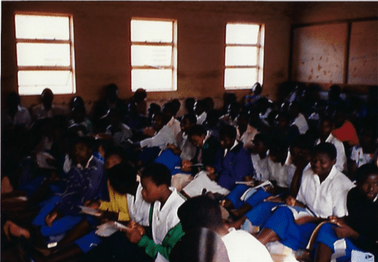
One of my Form 2 classes, more than 100 kids all on the floor.
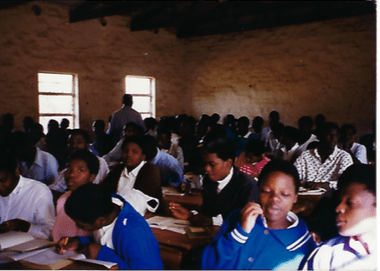
By the time the kids get to Form 4 they are styling with desks but still crammed – 200 in this one class.

You will enjoy this book if you happen to have been a Peace Corps Volunteer in Malawi… or if you want to imagine life in another culture…and/or if you are a fan of plucky heroes who overcome great odds to do something really amazing and great.

Reporting Back – I Love the Love that Darnell Moore Embodies

Darnell Moore came to our book group discussion – No Ashes in the Fire.

I wrote recently about how I loved No Ashes in the Fire by Black LGBTQ activist Darnell Moore. Yesterday I was able to break away from usual Saturday activities (which included 4 hoops games and two birthdays including my oldest son’s) to join other members of the SOMA Justice book club in a special event. We got to meet Mr. Moore and hear him speak about his life and his experience writing his memoirs.

How to describe the experience? Simply, love.

Love is the central theme and feeling that Mr. Moore conveys in both his writing and his speaking. He describes the love his mother and family has shown for him as Radical Black Love. He was loved intensely for himself, as an LGBTQ individual, even before he was able to love himself and admit to his family that he is LGBTQ.

He also spoke about his relationship with his father and his friendships with other black students while he was at Seton Hall. It was clear though that his mother’s love and acceptance allowed him to love himself and to stop punishing himself for his perceived sin of being LGBTQ.

Hearing him speak was to feel his love, it was a truly moving experience.

The Friend by Sigrid Nunez Wasn’t On My Radar…

Quick review of The Friend by Sigrid Nunez

…Should It Be On Yours?

Last Sunday evening a friend who reads a ton and who happens to be a published author (i.e. knows much more than me) offered me her copy of The Friend by Sigrid Nunez (2018, 212 pages). At some points in my life I’m more in tune with the NY Times reviews, news of literary awards and lists of best-of books, but now is not one of those times. So I totally hadn’t heard of the book even though it won the National Book Award for fiction in November.

(No, Rocket is not in the book but he’s cute and I needed some more visual interest.)

I found it very compelling and gobbled it up fast. Set in NYC, the narrator is mourning a very dear friend’s death by suicide. While confronting her own sorrow she is then asked to care for the dog he left behind…a Great Dane that weighs 180 pounds and is also seriously distraught over his master’s demise. And her rent-stabilized building does not allow dogs….

The dog, Apollo (the only named character in the book), and the narrator slowly grow accustomed to each other and in so doing, they both begin to heal. (Dog Lovers please note that the book is not solely focused on the dog so if you’re in it just for him you may be disappointed in spots.)

The writing style can seem quirky. Written in 12 parts with some sections written almost in snippets, it seems at times like Stream of Consciousness ramblings. However there are generally points to the streams that support the story, make a point, or inject humor. They didn’t bug me that much. Plus the entire book is slim, so if you find it annoying it’s only for 212 pages.

There are also many, many literary references. The narrator teaches writing and is an author, and her deceased friend was similarly a writer and a teacher. O’Connor, Simenon, Flaubert, Woolf, Keats, Auden, Coetzee, Ackerley, Kafka, Patterson… these are just a few of the authors whose words, works or ideas or mentioned or discussed in more detail. I knew some of them but had to look many up!

As we near the end of the book, tension mounts over the health of the aging, arthritic Apollo. There is a surprise in store for the reader which I didn’t see coming at all. It gives cause to more carefully contemplate the book title. To which friend is Nunez referring?

I recommend it! Give it a whirl! (Mine is a borrowed copy so unfortunately cannot lend out!)

Coming of Age Black & Free in America – A Memoir

Compelling memoir about LGBTQ Black activist Darnell Moore.

BLM, LGBTQ Autor
Darnell L. Moore, photo by Eric Carter in the NYT.

I just devoured Darnell L. Moore’s memoir No Ashes in the Fire: Coming of Age Black & Free in America (2018, 256 pages) and highly recommend it for several reasons.

Love – I love the love described throughout the book. Moore is not always aware of the love of others and needs to learn how to accept it. His path to awareness and acceptance is the central theme of the book. Self love, black love, parental love, family love, love between friends, romantic love, label-defying love – all of these are examined in beautiful writing. I especially adored his relationship with his mom – though you’ll have to read the book to get to my favorite scene between them.

Education/awareness – Moore writes extensively of his childhood and adolescence in Camden NJ. Camden is generally known as a blighted city but now I’ll look at it much differently. Moore describes the city with love and describes how the neglect of elected officials lead to its decline.

SOMA Justice chose this book for its February book club and Darnell Moore will be attending the discussion next week.

SOMA Justice chose this book for its February book club and Darnell Moore will be attending the discussion next week…PM me for more information!

Black Lives Matter – As a white woman, the book gave me tremendous insight about growing up as black boy in our white-centered world. Worthwhile reading for anybody seeking to understand where other people are coming from. The epilogue also describes how Moore helped organized Ferguson MO rallies after Michael Brown’s murder.

BOTTOM LINE – Fast, worthwhile read. I read it on my Kindle App so don’t have to lend.

How to Begin to Enjoy Elena Ferrante without Reading My Brilliant Friend.

Get a taste of Elena Ferrante by reading The Lost Daughter.

Don’t let the cover freak you out.

If you tried to get into My Brilliant Friend but just couldn’t do it, I highly recommend trying The Lost Daughter. It’s like a small dose of Elena Ferrante that you can delve into without 1,681 pages of extra intricate characters, relationships, families, feuds, and nicknames. 

The Lost Daughter is 140 pages long. It pulled me right in so I’m reading it quickly. That’s right, I haven’t finished yet. But I will soon and it will keep me on track for 52 books this year.

You can borrow it when I’m done! Or get a copy at Words, where I found mine.

UPDATE: I finished it! You really get into the narrator’s mind as she wrestles with the struggles of motherhood and sense of self.